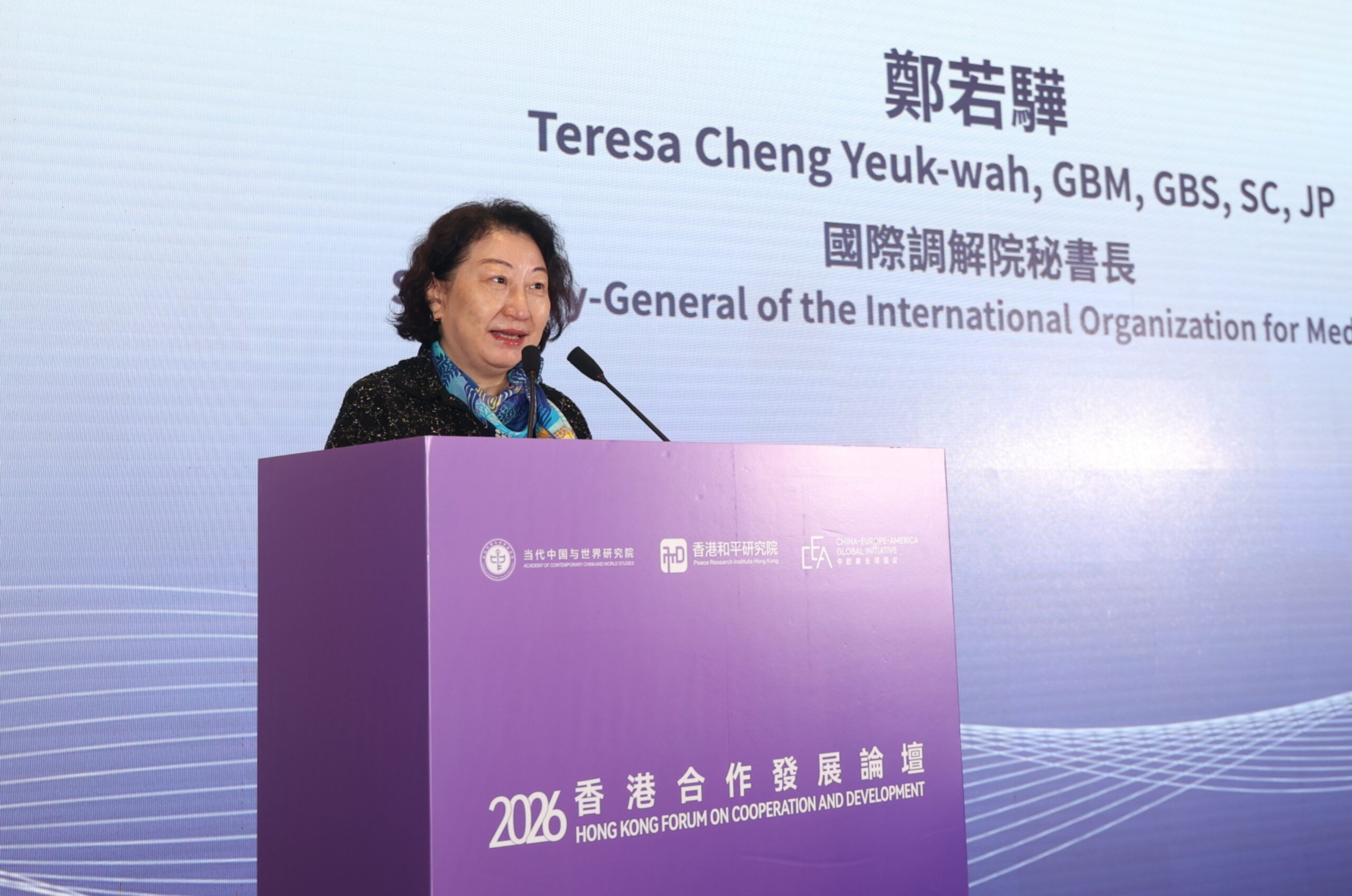
On 19 May 2026, Secretary-General Prof. Teresa Cheng attended the 2026 Hong Kong Cooperation and Development Forum co-organized by the Academy of Contemporary China and World Studies, the Peace Research Institute Hong Kong, and the China-Europe-America Global Initiative.
The Forum was held under the theme “Cooperation and Development: Advancing the Building of a Community with a Shared Future for Humanity”. In her remarks in the opening session, Prof. Cheng highlighted that the purpose and objectives of IOMed aligns with the goal of building a community with a shared future for humanity, and that mediation, by rebuilding trust and promoting dialogues, helps strengthen the foundation for cooperation and development.
Following is the full text of remarks by the Secretary-General at the Forum on 19 May 2026:
Distinguished guests,
Ladies and gentlemen,
Good morning! On behalf of the International Organization for Mediation (IOMed), I express our sincerest thanks to the organizers for inviting us to speak at this particular forum. The theme of this forum “Cooperation and Development: Advancing the Building of a Community with a Shared Future for Humanity” is very apt at this point in time, and more importantly, the spirit of which aligns very much with the purpose and objectives of the International Organization for Mediation.
To achieve this aim in the theme, I believe we at least have to do these three steps. We have to embrace peaceful coexistence, practice diversity, and harness mutual respect. To realize these, we have to engage in dialogue.
Mediation is an extension and a best practice of dialogue. It helps to resolve disputes peacefully, build trust, and preserve relationships. They allow the very foundations of cooperation and development to be actually achieved.
In the IOMed Convention, it states this, “The purposes and objectives of the Organization shall be to promote and facilitate peaceful settlement of international disputes and to develop friendly relations and cooperation among States through mediation.”
Mediation demonstrates the power of dialogue and understanding. It harnesses and allows cooperation and development to take place.
In recent days, the world is very much in a chaos. The international conflicts around the world have caused a lot of concerns.
Yet, there are also positive signs. President Chang just mentioned the visit and meetings between the United States and China just a few days ago. And of course, the meeting between the heads of state of Russia and China again in these two days. These are all prime examples of dialogue leading to a positive development.
We also hear about how Pakistan is mediating the conflict between Iran and the US, and aim to cool the current war in the Middle East.
The Chief Executive of the Hong Kong SAR gave a special address at the Global Mediation Summit of the IOMed last Friday, and if I may quote what he said, “In these perilous times, when global affairs have become increasingly complex and volatile, the pursuit of peace – and peaceful resolutions – is imperative.” It is for that reason mediation comes in at the very right moment and can actually contribute to the peace that we all aim to achieve.
Mediation is an extension of negotiations. A good mediator – and in the IOMed regime we call it the Mediation Commission because it can be more than one mediator – will be able to break the ice between the disputants, build trust on the Mediation Commission, and also rebuild trust between the two parties. They will also be able to allow the disputants to be forward-looking, focusing on shared interests as opposed to the rights and wrongs. In that way, the Mediation Commission will then bridge the emotional impasse and overcome the hurdles of emotions and historical background to the disputes.
The benefits of mediation actually are very much appreciated. In the UN Charter, mediation is listed as one of the very first means to resolve disputes peacefully.
Realizing the need for an international organization to be set up amongst states and based on convention, 19 states including China made a joint statement to that effect. That led to a multilateral discussion that practices diversity, and a good negotiation led to the conclusion of the IOMed Convention. The Convention opened for signature since 30 May 2025, and on that very day, 33 States signed up. In October 2025, the IOMed was set up and came into operation. At that point in time, there were 8 States that have ratified the Convention, and a representative of each of these states became members of the Governing Council. To date (as of 18 May 2026), we have 42 states that are Signatory States, 13 of which have ratified.
One can see the speed and the increasing number of States that are participating in the building and practice of the International Organization for Mediation, which actually shows their belief, trust and support for the very cause of mediation itself.
The International Organization for Mediation conducts two main objectives. One is to administer cases and the second is to carry out capacity building activities.
We administer three types of cases, State-to-State disputes, investor-State disputes, and international commercial disputes. I am very happy to tell you that we have already engaged our mediation administration services and there are successful stories. Given mediation is confidential, I am only allowed to divulge information that are agreed to be shared publicly by the parties and the mediator.
Therefore, I announced last Friday at the Global Mediation Summit that one of the cases that have been successfully mediated is a maritime dispute involving charterparty chain.
If I may return to the theme, “shared future” requires joint efforts. No one State or individual can aim to achieve such a mammoth and very important task. To build a community with a shared future for humanity, joint efforts are indispensable. We hope that we will be able to join hands to create a culture where our mindset is changed, so that we cherish dialogue and not confrontations; we aim to achieve a win-win and not a zero-sum game; and of course, we aim for positivity of the future and not focus on the negativity from the past.
With all of this, we hope to build a global mediation ecosystem which we believe will contribute to a more peaceful and cooperative environment for a brighter community with a shared future for humanity.
I thank you very much for your attention.